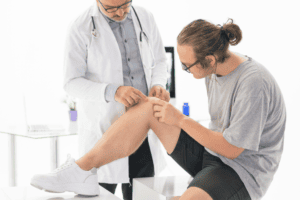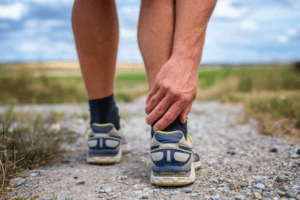

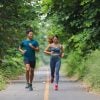


You lace up your shoes, head out for a summer run, and about a mile in you feel it: a dull, nagging ache around the front of your knee. You slow down, shake it off, keep going. By the next run it is back, a little worse. This is the classic story of runner’s knee and it is one of the most searched orthopedic conditions in the country every summer. The good news is that most cases resolve without surgery when treated correctly and early.
What Is Runner’s Knee?
Runner’s knee is the common name for patellofemoral pain syndrome (PFPS), a condition involving pain at or around the kneecap (patella) where it meets the thighbone (femur). The kneecap sits in a groove and is supposed to track smoothly as you bend and extend your leg. When it does not, repeated friction creates inflammation, pain, and over time, cartilage wear.
It affects runners disproportionately because running places three to five times your body weight across the knee joint with every stride. Multiply that by several thousand strides per mile and you can see why the joint breaks down when alignment or mechanics are off.
What Causes Runner’s Knee?
Runner’s knee is almost always the result of how load is being applied to the kneecap rather than a single injury event. Common causes include:
- Overuse from increasing mileage too quickly, especially at the start of summer training
- Weak quadriceps or hip muscles that fail to keep the kneecap properly aligned during the running stride
- Tight IT band or hamstrings that pull the kneecap off its normal tracking path
- Overpronation (inward rolling of the foot) that shifts stress up through the knee
- Running on hills or uneven terrain that changes how force is distributed through the joint
In many cases, runner’s knee is not purely a knee problem. It is a full-body mechanics problem that shows up in the knee because that is where the stress concentrates.
Signs Your Knee Pain Is Runner’s Knee
The symptoms are fairly recognizable:
- A dull, aching pain at the front of the knee or around the kneecap during or after running
- Pain that worsens going downstairs, squatting, or sitting with a bent knee for long periods (sometimes called the “movie sign”)
- A feeling of grinding, clicking, or stiffness in the knee
- Pain that starts mild and progressively builds over multiple runs if not addressed
If pain is sharp, occurs at the side of the knee, or is accompanied by significant swelling, the issue may be something other than patellofemoral pain syndrome, such as an IT band injury or a meniscus problem, and a proper evaluation is important.
How to Treat Runner’s Knee at Home
Early and consistent runner’s knee treatment can be highly effective when started before the condition becomes chronic:
- Reduce or pause running and substitute with low-impact activity like swimming or cycling
- Ice the knee for 15 to 20 minutes after activity to manage inflammation
- Strengthen the glutes, hips, and quadriceps to reduce the load on the kneecap
- Stretch the IT band, hamstrings, and hip flexors regularly
- Check your running shoes for wear patterns and replace if the midsole is compressed
Over-the-counter anti-inflammatories can help manage discomfort in the short term, but they do not address the mechanics driving runner’s knee. If symptoms do not improve within two to three weeks, conservative home care is not enough on its own.
When to See a Knee Specialist in Little Rock
Seeing a knee pain specialist in Little Rock makes sense when:
- Pain has persisted for more than two to three weeks despite rest
- You have visible swelling or significant mechanical symptoms like locking or giving way
- This is a recurring problem that keeps coming back each training season
- You are preparing for a race or event and need a structured return-to-running plan
An early diagnosis from our orthopedic team in Little Rock allows us to identify the specific mechanical issue driving the problem and build a treatment plan that addresses it directly, not just the symptoms.
Treatment Options at OrthoArkansas
Our approach to runner’s knee therapy starts with a thorough evaluation that looks beyond the knee itself. Treatment is almost always non-surgical and may include:
- Physical therapy targeting hip and quadriceps strength to improve kneecap tracking
- Gait analysis and running form assessment to correct mechanics at the source
- Knee taping or bracing for short-term pain relief during the rehabilitation process
- Custom orthotics to address overpronation or other foot mechanics contributing to the problem
- Corticosteroid injection in select cases for significant inflammation
The small percentage of patients who do not respond to conservative care may be candidates for minimally invasive procedures. Our orthopedic doctor for knee pain in Little Rock will discuss all options with you clearly before recommending any next step.
Why Choose OrthoArkansas for Knee Care in Little Rock?
OrthoArkansas brings together fellowship-trained orthopedic specialists, in-house physical therapists, and advanced imaging at multiple locations across Central Arkansas. We treat runners at every level and understand that getting back on the road is the goal, not just eliminating pain. Our team builds recovery plans that are designed to keep runner’s knee from becoming a recurring problem season after season.
Start Running Again, the Right Way
Knee pain does not have to end your summer. Schedule an appointment with our knee pain specialist in Little Rock at OrthoArkansas and get a clear diagnosis and a plan that actually works.
Book Your Knee Evaluation at OrthoArkansas
Frequently Asked Questions
Is runner’s knee the same as patellofemoral pain syndrome?
Yes, runner’s knee is the common name for patellofemoral pain syndrome (PFPS). The condition involves pain at or around the kneecap where it contacts the thighbone during movement. It is called runner’s knee because runners are among the most commonly affected, though it also appears in cyclists, hikers, and other active individuals.
How long does runner’s knee take to heal?
Recovery time varies depending on how long symptoms have been present and how well the underlying causes are addressed. Many patients notice meaningful improvement within four to six weeks of structured rehabilitation. Cases that have been ignored or pushed through for multiple training cycles may take longer. Starting treatment early gives you the best chance of a faster recovery.
Can I keep running with runner’s knee?
Continuing to run through runner’s knee pain is generally not recommended, as it can worsen inflammation and delay recovery. Low-impact alternatives like cycling, swimming, or using an elliptical trainer allow you to maintain fitness while the knee settles down. A graduated return-to-running program should be the goal rather than complete rest followed by jumping back in at the same volume.
What exercises help runner’s knee?
Strengthening the glutes, hip abductors, and quadriceps is the foundation of runner’s knee rehabilitation. Exercises like clamshells, side-lying leg raises, terminal knee extensions, and step-downs are commonly prescribed. Stretching the IT band, hip flexors, and hamstrings also plays an important role. Your OrthoArkansas physical therapist can build a program specific to your mechanics and current fitness level.
Does runner’s knee require surgery?
The vast majority of runner’s knee cases resolve with non-surgical treatment including physical therapy, activity modification, and addressing underlying biomechanical issues. Surgery is rarely needed and is generally only considered when a patient has not responded to a full course of conservative care. Your OrthoArkansas care team will discuss all appropriate options based on your specific evaluation.
What causes runner’s knee to come back after it seems to have healed?
Recurrence is common when the root cause is not fully addressed. If a runner returns to training at the same volume using the same mechanics without correcting the muscle weaknesses or movement patterns that caused the problem, the injury tends to return. A full rehabilitation program that includes strength work, gait correction, and a gradual return-to-running protocol significantly reduces the chance of recurrence.
Can runner’s knee affect people who do not run?
It can. Despite the name, patellofemoral pain syndrome affects cyclists, hikers, soccer players, and anyone who places repetitive stress across the knee joint. It is also common in people who spend long periods sitting with bent knees, which is why office workers occasionally develop it without any running at all. The treatment principles are the same regardless of what activity triggered it.
How do I prevent runner’s knee when increasing my training?
The most effective prevention strategies include increasing mileage gradually using the 10 percent rule, building hip and glute strength before ramp-up phases, replacing running shoes regularly, and addressing any overpronation with appropriate footwear or orthotics. If you have had runner’s knee before, a gait analysis at OrthoArkansas in Little Rock can identify the specific mechanics to correct before the next training cycle begins.